
CULTURE SUPERNATANT
What Is Stem Cell Culture Supernatant?
SUPERNATANT
About Stem Cells and Stem Cell Culture Supernatant

The term "stem cell" is widely known, but "stem cell culture supernatant" may still be less familiar.
It is the clear liquid drawn from the medium in which stem cells have been cultured, and understanding what it does means first understanding what stem cells do.
Each of these capabilities is explained below.
STEM CELLS
About Stem Cells
Stem cells hold a special capacity
to generate many kinds of cell.
Stem cells are the foundation of a living body. Just as the trunk of a tree branches out as it grows, they are special cells able to generate the functional cells needed to form organs and tissue — blood cells, muscle cells, nerve cells and more.
A wound in the skin heals because stem cells in the skin generate new skin cells, and the liver regenerates because stem cells in the liver generate hepatocytes.
In short, stem cells hold the key to the human body's natural healing power.
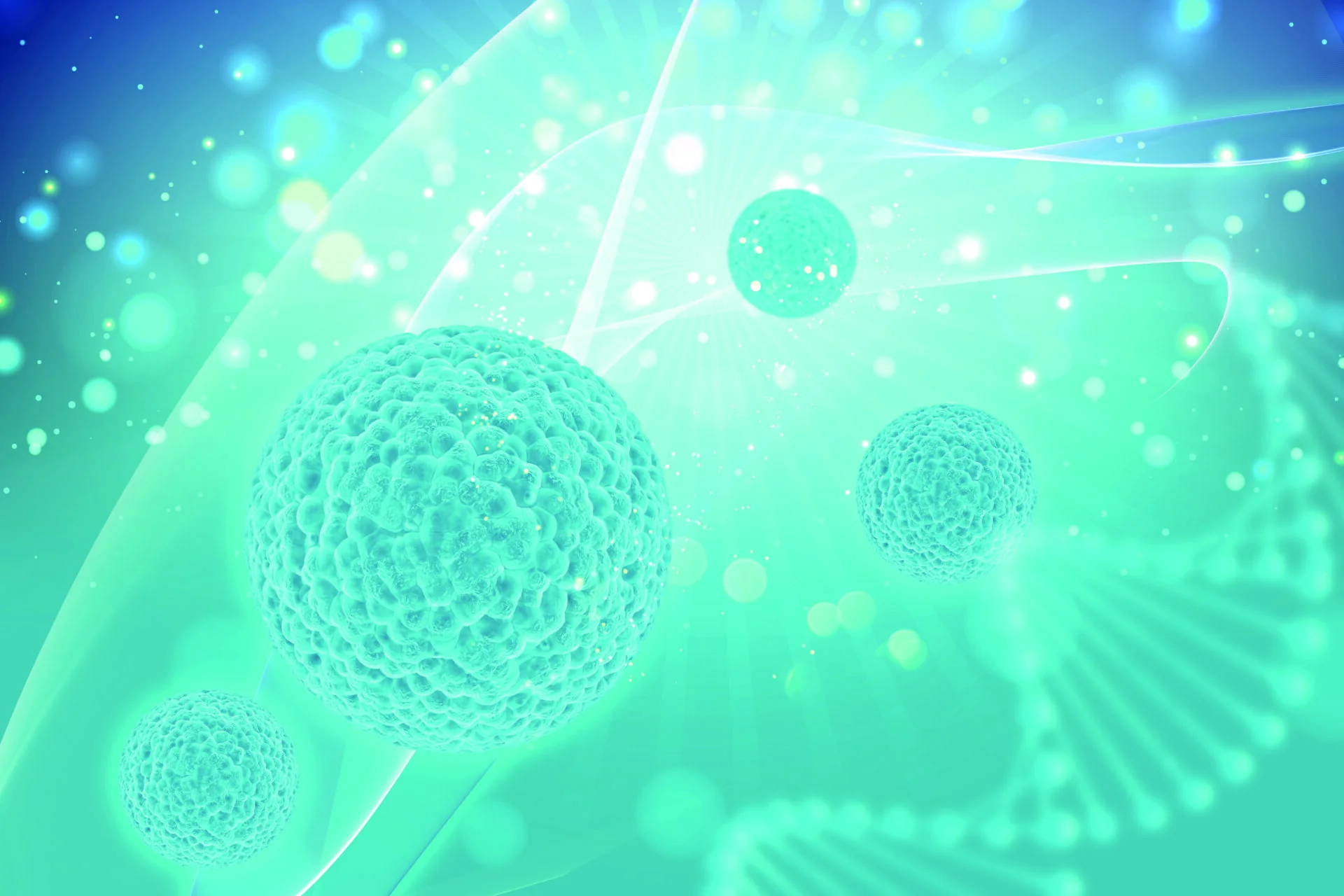
Stem cells are distinctive in combining
self-renewal with the capacity to differentiate.
Unlike functional cells, stem cells can divide any number of times and produce copies of themselves — a capacity known as self-renewal.
At the same time, stem cells can differentiate into cells with a wide range of functions different from their own, a capacity known as multipotency.
Having both self-renewal and multipotency is why stem cells hold the distinctive power to generate many kinds of cell.
As stem cells generate new cells,
the body changes constantly and stays healthy.
Our bodies appear to stay the same, but in fact they are changing constantly.
The functional cells that sustain life have a fixed lifespan, and metabolism proceeds as new cells are continually born and replace them.
Red blood cells, for example, reach the end of their life in 120 days, liver cells in 200 days, and epidermal skin cells regenerate in two to seven days.
Cells that reach the end of their life are called "functional cells," and it is "stem cells" that generate new cells to replace them.
Aging is
a decline in stem cells.
Behind the aging of the human body lies a decline in the number of stem cells.
Our bodies are made up of about 200 types of cell, 37 trillion in all.
Every tissue and organ that sustains life is formed from functional cells gathered together.
Each of these functional cells has a lifespan; when it ends, the cell dies, and stem cells generate new cells. This cycle repeats continuously and keeps us healthy.
Taking a newborn as 1, for example, the mesenchymal stem cells present in bone marrow and fat are said to fall to 1/10 in one's teens and 1/200 by age 80.
As stem cells decline with age, wounds and fractures become harder to heal。
Even at 80, however, stem cells remain at a ratio of 1/200, and regeneration remains possible.
There are hopes of putting that regenerative capacity to use in regenerative medicine.
CULTURE
Two-Dimensional and Three-Dimensional Culture
Two dimensions or three:
the difference between culture methods.
Cells can be cultured in two dimensions or three, and the state and character of the cells differ accordingly.
We use two-dimensional culture, which demands effort and thorough management.
Here is what characterizes each.
Two-dimensional culture

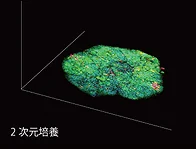
In two-dimensional culture, cells touch one another on a single plane, and signals pass between them laterally only. Medium and reagents are supplied directly from above.
- Cell shape
- Flat and stretched out.
- Contact between cells and medium
- Every cell is exposed evenly to the components of the medium.
- Cell-to-cell junctions
- Few cells show junctions with one another, unlike the physiological environment.
- Cell differentiation
- The cells differentiate relatively little.
- Drug sensitivity
- The cells are highly sensitive to drugs, and drugs show strong efficacy.
- Cell proliferation
- The proliferation rate is higher than in the natural environment.
- Survival rate
- Highly sensitive to cytokines.
Three-dimensional culture

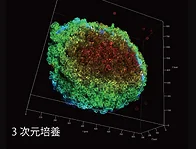
In three-dimensional culture, cells touch one another in three dimensions, and signals pass between them in all directions.
Cells on the inside do not touch the medium or reagents directly; these reach them by diffusion.
- Cell shape
- The natural, rounded shape is preserved.
- Contact between cells and medium
- As in the physiological environment, there is a gradient in the concentration of medium components around the cells. Cells nearer the surface are exposed to more of the medium than those deeper in (uneven exposure).
- Cell-to-cell junctions
- Junctions between cells are widespread, allowing communication between them.
- Cell differentiation
- The cells differentiate steadily.
- Drug sensitivity
- The cells often show resistance, and drugs are less effective.
- Cell proliferation
- The proliferation rate varies with the cell type and the three-dimensional culture technique used.
- Survival rate
- The survival rate is high, with low sensitivity to external factors.
WHAT IS IT
What Is Stem Cell Culture Supernatant?
The important role played by
the supernatant from cell culture.
"Stem cell culture supernatant" refers to the clear liquid obtained in the course of culturing stem cells.
Research and treatment involving stem cells has generally meant stem cell transplantation: culturing and expanding stem cells and then transplanting them.
Research by the group of Professor Emeritus Minoru Ueda at the Nagoya University Graduate School of Medicine, however, showed that the supernatant is rich in cytokines (growth factors) and that these play an important role in cell regeneration.
This led to a reassessment of the efficacy and safety of stem cell culture supernatant.

The important effects
of stem cell culture supernatant.
Stem cell culture supernatant contains a variety of bioactive substances and is said to have four main biological effects.
These cytokines prepare the environment for the regeneration of tissue and organs, and regeneration can be expected.
① Anti-inflammatory effect The bioactive substances in stem cell culture supernatant suppress inflammation and ease inflammation in tissue, preparing the environment for regeneration.
② Promoting cell proliferation and differentiation Cytokines promote cell proliferation and differentiation, supporting the repair and regeneration of damaged tissue.
③ Promoting angiogenesis The components of stem cell culture supernatant promote the formation of new blood vessels, supplying tissue with sufficient oxygen and nutrients and so promoting regeneration.
④ Antioxidant and anti-stress effect Stem cell culture supernatant contains antioxidants, which protect cells from oxidative stress, maintaining the health of tissue and promoting regeneration.
DIFFERENCE
The Difference Between Stem Cell Treatment and Stem Cell Culture Supernatant Treatment
Stem cell culture supernatant treatment
has a strong safety profile.
Conventional stem cell treatment and the newer stem cell culture supernatant treatment aim at the same effect, but the way treatment proceeds is very different.
Stem cell culture supernatant treatment compares favorably with stem cell treatment in many respects, which should widen the range of patients able to receive treatment.
It also has the advantage that, because it contains no cells (cell-free), the risk of malignant transformation and similar risks is extremely low.
OUR APPROACH
About Stem Cell Culture Supernatant at BiOStyle Clinic
Our clinic specializes in treatment using amniotic membrane and cord blood.
Among the many stem cell culture supernatants available, we explain here why we focus on amniotic membrane and cord blood rather than fat alone.
Why we focus on amniotic membrane and cord blood.
Their cytokines are wide-ranging and varied,
with promise across many conditions.
Stem cells are used to produce stem cell culture supernatant.
Four kinds of stem cell are widely known.
• Dental pulp stem cells from children's baby teeth
• Stem cells from bone marrow
• Stem cells from human abdominal fat
• Stem cells from the amniotic membrane and cord blood of newborns
Alongside the widely used stem cells from fat, BiOStyle Clinic focuses on culture supernatant produced from stem cells derived from amniotic membrane and cord blood.
Amniotic membrane and cord blood are rich in stem cells, and collecting them is relatively straightforward, with little pain or burden.
This allows patients to receive treatment with confidence.
The amniotic membrane is a protective membrane for the fetus and is rich in growth factors and extracellular matrix.
These components are thought to play a role in promoting regeneration and repair in treatment.
Cord blood, likewise collected from the fetus, yields a wide variety of stem cells.
Amniotic membrane and cord blood each have their own characteristics, and we consider that they complement one another in treatment.
We believe this allows us to provide the treatment best suited to each patient.