

What Is nanoPDS, a Completely New Penetration Technology?
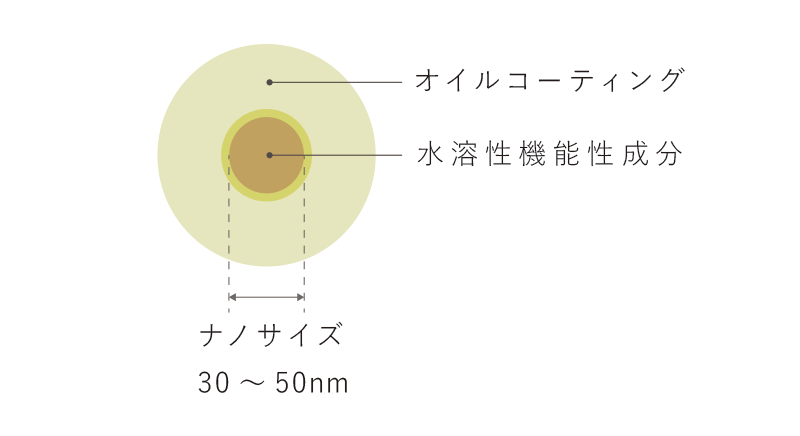
“nanoPDS” (Nanoparticle Delivery System) is one of a new generation of penetration technologies, built on an application of DDS (Drug Delivery System). This technology turns high-performance ingredients into nanoparticles, allowing high-molecular-weight raw materials that are normally difficult for the body to absorb to be absorbed through the skin. Without heat and in an anhydrous form, it can deliver active ingredients themselves directly and quickly deep into the skin, all the way to the stratum corneum, without breaking down the ingredients’ properties. DDS is a technology that finely controls the dose, site, and timing of a drug’s action inside the body, maximizing its effect, reducing side effects, and lessening the burden on the patient — and nanoPDS is built on this DDS foundation. It wraps hydrophilic ingredients in a surfactant, forming tiny particles a few hundred nanometers in size that can be dispersed in oil. This technology improves penetration into the skin: hydrophilic ingredients with a large molecular weight normally cannot pass through the skin’s barrier function, but this technology allows them to penetrate into the skin. Research has also shown that proteins and other substances that penetrate into the skin retain their activity, keeping their original properties and functioning properly. nanoPDS enables transdermal delivery of high-molecular-weight or unstable ingredients such as vitamin C and hyaluronic acid, and is already applied in cosmetics development. Going forward, it is expected to be applied to a wide range of ingredients beyond cosmetics as well.

Cosmetic Ingredients Generally Do Not Penetrate the Skin
It is often said that cosmetic ingredients generally have difficulty penetrating the skin. This is because their molecular weight is too large to enter the body. As a rough guide, only ingredients with a molecular weight of 500 or less can penetrate normal skin. Molecular weight is the sum of all the atomic weights in a molecule; water has a molecular weight of 18.0 (H = 1.010 × 2 + O = 16.0). That is why water passes through the skin. The reason your fingers wrinkle after a long bath is that water molecules have penetrated the skin.
Hyaluronic acid, a well-known beauty ingredient, has a molecular weight of around 1 million, and collagen around 300,000 — both far too large to normally penetrate the skin. Ingredients with both fat-soluble and water-soluble properties, on the other hand, penetrate the skin more readily. This relates to the nature of the skin itself: the stratum corneum readily absorbs fat-soluble ingredients, while the layers beneath it more readily absorb water-soluble ingredients. Removing the stratum corneum increases the skin’s absorptive capacity, but because it also serves a barrier function, removing it too frequently can irritate the skin and cause skin trouble.
PDS technology is a groundbreaking technology that enables transdermal absorption even of high-molecular-weight raw materials with a molecular weight of around 2 million. By nano-coating beauty ingredients in particle form with oil, it increases their affinity with the skin and delivers them deep within.
Absorption-Controlled DDS via the Skin and Mucous Membranes
DDS is a system that enhances a drug’s effect, reduces side effects, and improves the patient’s quality of life by controlling how the drug behaves inside the body. Because a drug’s structure cannot incorporate every necessary property — efficacy, safety, stability, absorbability, sustained action, target specificity, and so on — all at once, DDS technology has in recent years drawn attention for new substances such as peptides, proteins, DNA, and RNA.
DDS technology rests on three core techniques: (1) targeting (target-oriented DDS), (2) controlled release (release-controlled DDS), and (3) barrier penetration and absorption enhancement (absorption-controlled DDS). Targeting is a technique that concentrates delivery of a drug at the site of a lesion, and is classified into passive and active targeting. Controlled release is a technique that controls the timing at which a drug dissolves, based on the time elapsed after administration. Barrier penetration and absorption enhancement is a technology that improves drug absorption through the skin and mucous membranes and passage through the blood-brain barrier — and “nanoPDS ultra-transdermal penetration technology” is a groundbreaking technology that achieves exactly this kind of barrier penetration and absorption enhancement.
Particle Delivery That Penetrates Deep Into the Skin
By stirring at high speed, a hydrophilic drug dissolved in water is mixed with a hydrophobic surfactant dissolved in oil, forming a stable water-in-oil emulsion. The water is then removed from this emulsion, producing nanoPDS. This technology makes it possible to deliver a high concentration and a large quantity of a substance deep into the skin quickly. Conventionally, ingredients with a molecular weight of 500 or more were considered unable to stabilize and reach the dermis; they were thought to stay on the surface of the skin without penetrating deeper layers, because our outer surface is protected by the sebum film and the intercellular lipids of the stratum corneum. However, nanoPDS technology is able to absorb high-molecular-weight raw materials with a molecular weight of 500 to 2 million, and by nano-coating ingredients such as hyaluronic acid in particle form (wrapping them in oil), it can make them penetrate the skin. This allows the drug to be delivered deep within the skin.
Achieving Transdermal Penetration of High-Molecular-Weight Hyaluronic Acid
It has been found that dispersing hyaluronic acid in an oil-based carrier using PDS technology allows about 3.6 times more hyaluronic acid to penetrate the skin than ordinary water-soluble hyaluronic acid. This is because the hyaluronic acid can more easily pass through the hydrophobic stratum corneum and is more readily transported to the epidermis and dermis. Microscopic observation of a cross-section of the skin confirmed that the hyaluronic acid had indeed penetrated sufficiently. By contrast, ordinary water-soluble hyaluronic acid showed fluorescence in the stratum corneum, but the fluorescence in other tissues was very weak, indicating that only a very small amount penetrates deep into the skin.
The Value and Future Potential of nanoPDS
PDS is considered to be highly versatile, and beyond its application in cosmetics, it is also expected to find applications in fields such as pharmaceuticals and food. In pharmaceuticals, drugs that once had to be administered by injection may become usable in treatment simply by being absorbed through the skin. In addition, drugs that were previously difficult to administer to children or the elderly may be usable in a wider range of treatments, since absorption through the skin can reduce the burden of administration.
In the food field as well, processing nutrients that are difficult to dissolve in water, or fat-soluble vitamins, so that they can be absorbed through the skin is expected to enable more efficient nutritional support. This is expected to help elderly people and those in poor health, who may not be able to obtain sufficient nutrients through diet alone, lead healthier lives.
In the future, further advances in nanoPDS technology are expected to enable even more efficient absorption. This technology is also expected to contribute to the development and application of new high-molecular-weight compounds. Going forward, nanoPDS technology is expected to benefit even more people in the fields of medicine and food.