

REGENERATIVE
MEDICINE
PRP Therapy (Platelet-Rich Plasma)
ABOUT
About PRP Therapy
PRP therapy (platelet-rich plasma)
draws out the body's power to heal.
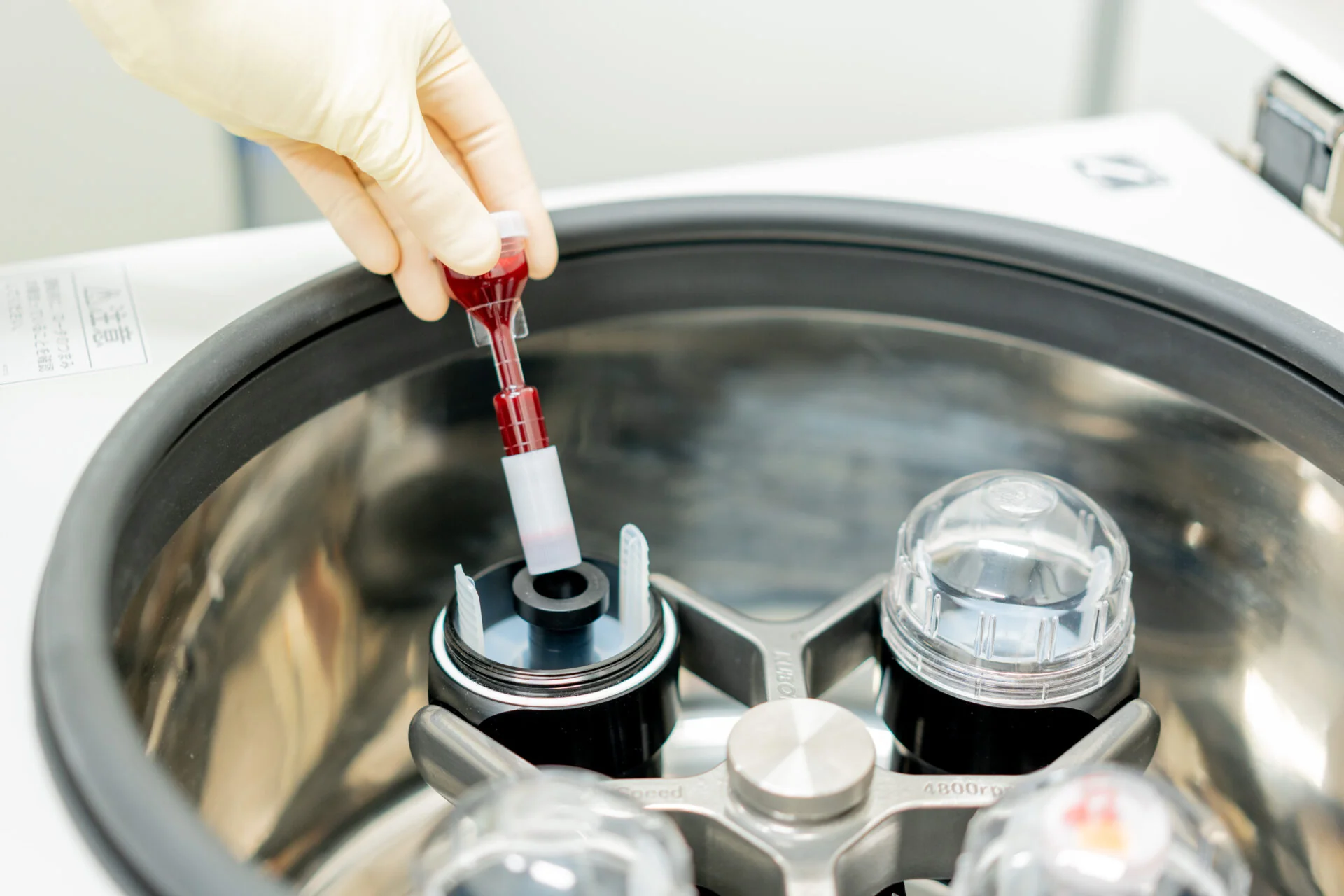
PRP, or platelet-rich plasma, is exactly what the name suggests: plasma rich in platelets, obtained by putting the patient's own blood through a centrifuge to concentrate the platelets.
Platelets naturally gather at a wound to stop bleeding while releasing growth factors that promote tissue repair.
This action advances the repair of damaged tissue and encourages the formation of new cells, so that the body's own healing power is drawn out.
PRP therapy applies this natural mechanism, aiming to repair damaged tissue and cells and to relieve pain.
The treatment deliberately includes a step that introduces a fine "new stimulus."
This makes an area that has become chronic and unresponsive recognize once again that there is something to repair, prompting a healing response.
Concentrated PRP then reinforces that repair capacity, guiding recovery through the body's own healing power — this is the thinking behind PRP therapy.
RECOMMENDED
Who It Is For
This treatment is recommended for those with the following concerns.
◎ Unhappy with your current treatment
◎ Shoulder or knee pain that will not go away
◎ Want to return to sport or work quickly
◎ Want to treat pain that has become chronic
◎ Unable to be treated because of a drug allergy
◎ Want to improve your skin quality
EFFECT
What It Does
A treatment with a strong safety profile
Because PRP uses components taken from the patient's own blood, allergic and rejection reactions are very unlikely — a major advantage.
Platelet-rich plasma concentrated from your blood is injected back into you as it is. Because only components of your own origin are used, the body is unlikely to react to them as foreign, and a high level of safety can be expected.
Also for difficult-to-treat conditions
PRP extracts the platelet-rich component of the blood and uses it to treat injuries and chronic pain.
The growth factors contained in platelets help drive the repair of damaged tissue. This draws out natural healing power, and recovery from injury and relief of long-standing pain can be expected.
It may offer an approach to stubborn conditions that have been difficult to improve, and how the effect appears differs from person to person.
Also promising for skin regeneration
PRP contains a wide range of growth factors and supports the repair and regeneration of skin tissue, so it is also applied in treatments for skin quality.
When PRP is injected into the skin, the growth factors promote collagen production and cell activity, increasing firmness and elasticity and helping to improve wrinkles and sagging.
Because your own blood is used, the risk of allergy or rejection is low, making this a skin treatment you can undergo with relative confidence.
Gentle on the body
PRP is given by injection, so no surgery or scalpel is involved and the burden on the body is small. Few visits are needed and treatment is completed in a day.
Scarring afterwards is hard to notice and the change in appearance is slight, which makes privacy easier to maintain. In most cases no rest is required, and you can return to your usual routine immediately after treatment.
Because the treatment works with natural healing power, the risk of allergy or rejection is extremely low, and a degree of benefit can be expected even for stubborn conditions.
FLOW
The Process
Get in touch
Contact us by phone or through the form.
Free consultation with a medical advisor
We cannot advise on whether a treatment is suitable for you at this stage, but we will explain the process and the costs involved.
Examination by a doctor
We confirm the final treatment plan.
Blood draw
The required amount of blood is drawn from the arm.
Centrifugation
The blood drawn is centrifuged to extract the plasma component.
Injection
The concentrated plasma component is injected into the treatment area.
FAQ
Frequently Asked Questions
 Patient
How soon does PRP treatment start to work?
 Physician
Usually within one to several weeks of administration. This varies with individual constitution, the treatment given, and the symptoms being addressed. Some patients feel an effect immediately after the PRP injection, and even then the effect is expected to build gradually. In many cases improvement continues with each session, and continued treatment can produce better results.
PatientHow long does the effect last?
PhysicianThe effect can last several months, and within that period the damaged area may heal — something seen particularly with sports injuries.
PatientHow many sessions should I have?
PhysicianThe effect and the number of sessions depend on each patient's condition and what is being treated. Some patients see a substantial effect from a single session, while others need several. Because the ideal number also depends on the state of the area and the goal of treatment, a detailed examination and consultation with a doctor is necessary.
PatientCan older patients receive this treatment?
PhysicianPRP treatment is generally regarded as safe, and there are few restrictions by age, so older patients can receive it with confidence. The PRP is prepared from your own blood in a process that is relatively simple and quick. It takes about 30 minutes and is completed in a single day.
PatientWhat is the difference between PRP therapy and stem cell treatment?
PhysicianPRP therapy and stem cell treatment take different approaches. PRP therapy uses the platelet component extracted from the patient's blood to enhance natural healing power and repair inflamed or damaged tissue; preparation is quick and the effect appears relatively soon, but it is temporary and does not last long. Stem cell treatment uses stem cells taken from inside or outside the patient's body; these can differentiate into a variety of cells and regenerate and repair damaged tissue. It can be applied to difficult tissues such as articular cartilage, is considered to last relatively longer, and can also be given by IV drip for a whole-body effect, with improved function expected.