

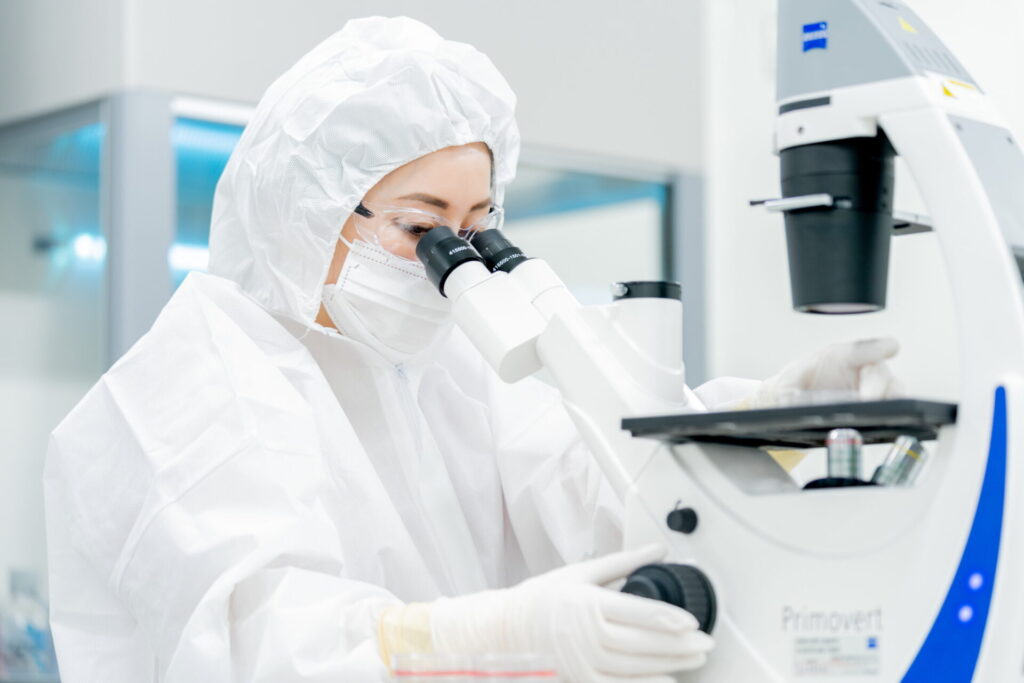
Regenerative medicine holds enormous promise as the medicine of the future.
However, its safety is supported not only by “technology,” but by environment, personnel, management systems, and ethics.
At BiOSTYLE CLINIC, we have clearly defined our safety standards for regenerative medicine in order to provide our VIP clients with care they can trust at its core.
Here, we introduce the key points we consider essential to “choosing a safe clinic.”
14 Checkpoints for Receiving Regenerative Medicine Safely
1. Does the Clinic Have Its Own Specified Cell-Processing Facility?
▶ Our clinic: We own our own specified cell-processing facility
Our clinic does not outsource cell processing; we maintain our own specified cell-processing facility on site.
By managing everything from cell collection through processing to administration under one roof, we maximize quality and safety.
Very few clinics have a specified cell-processing facility on their own premises.
2. Does the Specified Cell-Processing Facility Meet Air-Cleanliness Standards?
▶ Our clinic: Class 100 (equivalent to ISO Class 5)
Our specified cell-processing facility maintains Class 100 cleanliness, one of the highest standards in Japan.
We process cells in an environment that far exceeds the Class 10,000 standard typically required.
3. Are There Enough Cell Culture Technologists?
▶ Our clinic: A team of 6 or more
In culture work that demands intense concentration, understaffing is a risk factor.
Our clinic maintains a team of 6 or more technologists, working in shifts so that each can rest sufficiently while performing highly precise work.
4. Do the Cell Culture Technologists Have Sufficient Experience?
▶ Our clinic: Chief technologist: 17 years / all staff: 3+ years
Our chief cell culture technologist has 17 years of experience, and every other staff member has at least 3 years of experience.
Cell culture is a highly specialized field in which experience is directly linked to quality and safety.
5. Is There a Solid Education and Training System?
▶ Our clinic: Regular in-house training plus external courses
- Participation in public training programs
- Internal education led by the chief technologist
- Specialized training led by outside instructors
We have established a continuing-education system that keeps pace with the evolution of regenerative medicine.
6. Is There Close Coordination Between Cell Culture Technologists and Physicians?
▶ Our clinic: Direct coordination with in-person confirmation
- Direct explanation of cell condition
- In-person confirmation at the time of handover
We have built a system in which manufacturing and clinical care are never disconnected from one another, minimizing risk.
7. Is the Method of Cell Handover Safe?
▶ Our clinic: No freezing, immediate administration (within 5 hours)
We do not cryopreserve cells; they are administered within 5 hours of processing.
This avoids the damage and accident risk associated with freezing and thawing.
8. Is There Genuine Expertise in Regenerative Medicine?
▶ Our clinic: 8+ years of clinical experience
We have 8+ years of clinical experience across both health-focused and aesthetic medicine.
We also conduct joint research with university laboratories in pursuit of next-generation regenerative medicine.
9. Do Our Physicians Have Specialized Expertise?
▶ Our clinic: Members of academic societies, including board-level positions
- Membership in regenerative-medicine-related academic societies
- Service as society board members and officers
- Ongoing participation in academic research
We always provide care based on the most current medical knowledge.
10. Is There a Solid Emergency Response System?
▶ Our clinic: Capable of immediate response
- Emergency-response training
- Anaphylaxis response protocol
- CPR and emergency-response drills
- Emergency medications and equipment kept on hand
- Coordination with a university hospital’s emergency team
We maintain a fully prepared system for the unlikely event of an emergency.
11. Are In-House Research Sessions and Study Groups Held?
▶ Our clinic: Held on a regular basis
- Joint study sessions for physicians, cell culture technologists, and nurses
- Case sharing
- Research presentations
The quality of care is sustained by a continual commitment to learning.
12. Is the Equipment Needed for Regenerative Medicine in Place?
▶ Our clinic: Fully equipped
- Our own specified cell-processing facility
- Cell-testing equipment
- Vital-sign monitoring
- Emergency-response equipment
Regenerative medicine is highly dependent on equipment. We maintain a fully equipped environment.
13. Is Informed Consent Thorough?
▶ Our clinic: We clearly explain the risks
- Treatment details
- Expected effects
- Anticipated risks
- Our clinic’s safety system
Medical care that does not explain its risks cannot be called safe.
Our clinic provides careful explanations using booklets and materials.
14. In Summary: What Makes a Clinic Truly Safe
A truly safe clinic is one where:
- Safety manuals are properly maintained
- Protocols exist for responding to medical incidents
- All staff are trained
- Risks are correctly understood and shared with patients
These are essential conditions.
Rather than medicine that relies on excessive promotion or emphasizes only its effects, we believe that a stance that puts safety, quality, and medical ethics first is the true condition for a genuinely trustworthy medical institution.
The Philosophy of BiOSTYLE CLINIC
Regenerative medicine can only be provided safely once the right environment, personnel, and management systems are in place.
Under our integrated management of cell processing (our specified cell-processing facility), medical care (our physicians), and safety management (our systems),
we promise our VIP clients the genuine peace of mind and quality they deserve.